
Introduction
In our work with clients across different industries, we have noticed the same pattern show up again and again. A lead comes in, looks promising, gets one or two follow ups, and then quietly disappears from the pipeline. Nobody did anything wrong exactly. The lead simply was not ready yet, and nobody stayed in the conversation long enough to be there when they were.
We have seen this cost businesses real revenue, not because their lead generation was weak, but because the relationship stopped the moment it stopped being easy. A prospect who was not ready in week one is often ready by week six, but only if someone was still there to answer their questions when that moment arrived.
That gap between first contact and final decision is what lead nurturing exists to close. It is not a single follow up email or a one time discount code. It is the ongoing process of staying relevant, useful, and visible to a lead over time, so that when they are finally ready to buy, your business is the one they remember, not whichever competitor happened to still be around.
See Exactly Where Your Leads Are Being Lost
What Lead Nurturing Actually Means?
Lead nurturing is the ongoing process of building a relationship with a lead after they first show interest and before they are ready to make a purchase decision. It is not a single email or a one time discount offer. It is a structured sequence of touches, emails, content, occasional calls, retargeting, that keeps a business visible and useful while a prospect works through their own decision timeline.
We have found that roughly half of the leads any business generates are genuinely interested but simply not ready to buy the moment they first make contact. That is not a failure of the lead generation campaign. It is just how buying decisions work, especially for anything beyond a small impulse purchase. The businesses that treat that first contact as the only chance to convert are the ones who lose leads that would have converted with a bit more patience and the right follow up.
Why We Keep Seeing the Same Costly Mistake?
Across the accounts we manage, one thing shows up constantly. When a lead does not respond to the first or second outreach, most internal teams quietly stop trying. There is no bad intent behind this, sales teams are busy, and a lead that goes quiet feels like a dead end. But the data backs up what we see firsthand. Close to 80% of new leads never actually turn into a sale, and a lack of consistent nurturing is one of the most common reasons cited for that drop off.
What we have learned from watching this happen repeatedly is that a lead going quiet almost never means they lost interest completely. It usually means the timing was wrong, a budget cycle had not started, a decision maker was tied up, or they were simply still comparing options. Businesses that walk away after two attempts are handing those same leads to whichever competitor happens to still be in the picture when the timing finally lines up.
What Effective Nurturing Actually Looks Like?
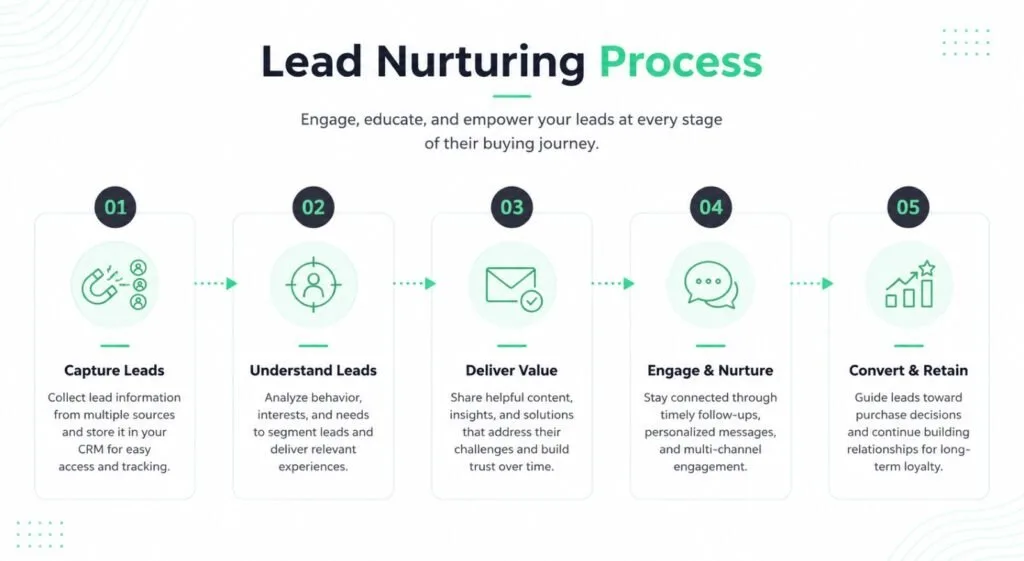
Good nurturing is not about sending more emails. It is about sending the right message, through the right channel, at a pace that respects where the lead actually is in their decision process. In practice, that tends to include a few consistent elements.
- Multiple touches over time: Conversion rarely happens after one interaction. Programs that stay in touch across email, retargeting, and the occasional direct check in tend to significantly outperform single channel follow up.
- Content that answers real questions: Not just promotional offers. A lead who is still comparing options responds better to something genuinely useful than to another discount code.
- Timing based on behavior: Not a fixed calendar. A lead who revisits a pricing page deserves a faster follow up than one who has gone quiet for weeks.
- Consistency without becoming noise: There is a real difference between staying present and becoming the sender someone eventually blocks.
Personalised, behaviour-triggered nurture sequences can be more relevant than generic, one-size-fits-all email blasts. The difference is not simply the tool being used. It is whether the message reflects where that specific lead is in their journey.
An Example Nurturing Workflow
Imagine a software company generating a steady flow of enquiries while only a small share are ready to book a demonstration immediately. Writing off every early-stage lead would discard people who may still have a genuine need but require more information or time.
A suitable nurturing sequence could combine educational emails, relevant case studies, occasional check-ins and carefully controlled retargeting. The purpose is not to manufacture urgency. It is to answer useful questions and make it easy for interested prospects to re-engage when their timing changes.
If follow-up stops after the first week, the business loses the opportunity to remain useful while those prospects continue evaluating their options.
What a Strong Nurturing Process Prioritises
A strong process prioritises relevance, permission and timing. It gives sales teams visibility into the content a lead has engaged with, the questions they have asked and the point at which direct contact would be genuinely useful.
Many buying decisions involve several interactions before a prospect is ready to commit. Rushing that process rarely creates trust; a clear sequence should make each interaction useful and give people a straightforward way to opt out.
Signs a Business Needs a Real Nurturing Process
A few patterns tend to repeat across the accounts we take on, and they usually point to the same underlying issue.
- Leads get one or two follow ups and then simply stop being contacted.
- There is no defined sequence, follow up depends entirely on whether someone remembers to do it.
- Every lead gets the same generic message regardless of what they actually showed interest in.
- Marketing hands off every lead to sales immediately, even the ones who are clearly still early in their research.
- Nobody is tracking how long it actually takes leads to convert, so there is no way to know if the follow up cadence even makes sense.
If more than one of these sounds familiar, the issue is rarely a lack of good leads coming in. It is what happens, or does not happen, in the weeks after that first contact.
How OutservePro Approaches Lead Nurturing?
As a dedicated digital marketing agency, this is the part of the process we spend the most time refining with clients, because it is also the part most internal teams never quite get around to building properly. At OutservePro, nurturing is built into every lead generation campaign from day one, not added afterward as an afterthought.
Every lead we bring in gets mapped to a structured follow up sequence based on how they engaged, what they showed interest in, and how close they appear to be to a decision. That means a lead who requested a quote gets treated very differently from one who simply downloaded a guide, and both get followed up with in a way that actually matches where they are, rather than a single generic sequence applied to everyone.
The result is fewer leads slipping away simply because nobody stayed in touch long enough, and a pipeline that keeps converting weeks or months after the first click, not just on day one.
The Bottom Line
Lead generation gets a lead to your door. Qualification tells you whether they are worth pursuing. Nurturing is what decides whether they actually stay long enough to become a customer, and in our experience, it is the step most businesses underestimate the most.
A lead that does not convert on day one is not a lost opportunity. It is usually just a lead that has not been given enough reason yet to remember you when they are finally ready. The businesses that win are rarely the ones with the most leads. They are the ones who stay present long enough for timing to finally work in their favour.
If your pipeline is full of leads that went quiet, the fix is rarely more traffic. It is a nurturing process that keeps you visible until they are ready to buy.
Stop Losing Your Leads — Contact Us Today!
FAQ’s
Frequently Asked Questions
How is lead nurturing different from lead generation?
Lead generation is about attracting and capturing initial interest. Lead nurturing is what happens afterward, the ongoing communication that keeps a prospect engaged until they are ready to buy. One brings people in, the other keeps them from disappearing before they convert.
How long should a lead nurturing sequence run?
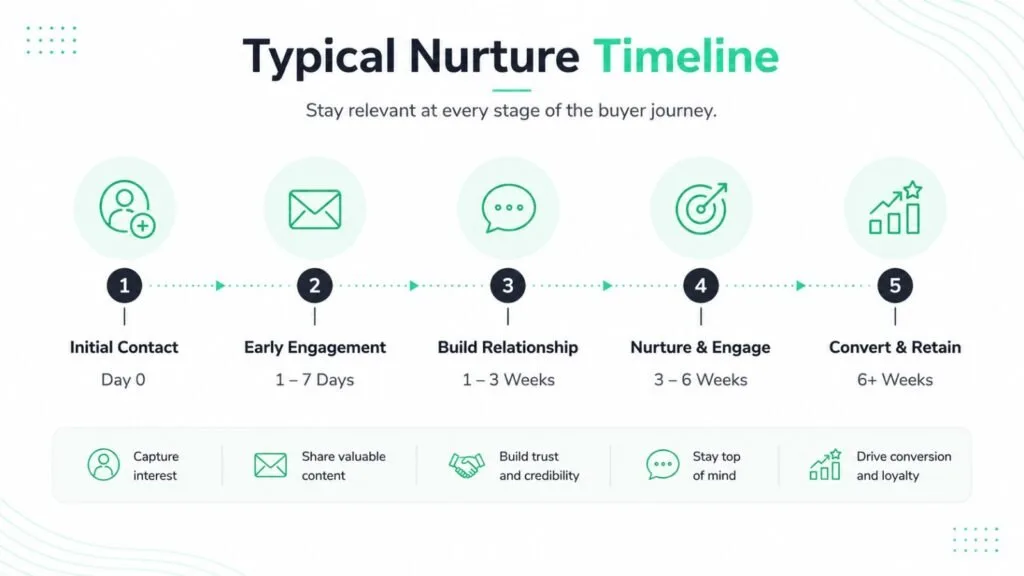
It depends on the complexity of the purchase, but many B2B nurture sequences run anywhere from a few weeks to few months, spaced out to mirror how buyers actually make decisions rather than rushing them toward a quick answer.
Is email still the best channel for lead nurturing?
Email remains the most commonly used and cost effective channel, but it works best when combined with other touches like retargeting ads or occasional direct outreach, rather than relying on email alone.
Does lead nurturing work for smaller businesses?
Yes. Smaller businesses often benefit even more, since they cannot afford to let a promising lead go cold simply because timing was not perfect on the first attempt.
What is the biggest mistake businesses make with lead nurturing?
Giving up too early. Most internal teams stop following up after one or two attempts, right around the point where many leads are just starting to seriously consider a decision.
What are some examples of lead nurturing content?
Common formats include educational emails, case studies, comparison guides, webinars, and retargeting ads that answer specific questions a lead is likely still working through. The goal is to stay useful, not just promotional, at every stage of the sequence.
How do you know if a lead nurturing strategy is actually working?
The clearest signals are rising response rates on later touches, leads re-engaging after periods of silence, and a growing share of nurtured leads eventually converting compared to those handed to sales without any follow up sequence. If none of these move over time, the sequence usually needs adjusting, not abandoning.