

What Is Lead Generation and How Does It Work?

No leads means no clients. Here is exactly what lead generation is, how it works, and what every business needs to know before investing in it.
Author
outservepro@gmail.com
Category
Marketing, Sales
Table of Contents
Introduction
Every business needs clients. But clients do not appear from thin air. Someone has to find them, earn their attention, and convert that attention into a conversation worth having. That process is lead generation, and without it, even the best product or service in the world sits undiscovered.
This guide explains exactly what lead generation is, how it works in practice, and why 91% of B2B marketers rank it as their single top priority in 2026. Whether you are building a strategy from scratch or trying to understand what an agency actually does when they say they will generate leads for you, this covers everything clearly.

What Lead Generation Actually Means?
Lead generation is the process of attracting people who might be interested in your product or service and capturing enough of their information to start a sales conversation. A lead is simply a potential customer who has shown some level of interest, whether by filling out a form, calling your business, clicking an ad, or downloading something from your website.
The goal is not to sell immediately. It is to identify people worth talking to before your sales team ever picks up the phone. Lead generation sits at the top of the sales funnel, feeding the pipeline that eventually produces paying clients.
Without a consistent flow of incoming leads, a business is entirely dependent on word of mouth, referrals, or outbound cold calling, none of which scale reliably. Lead generation creates a repeatable, measurable system for bringing interested people to your door.
Inbound vs Outbound: Two Very Different Approaches
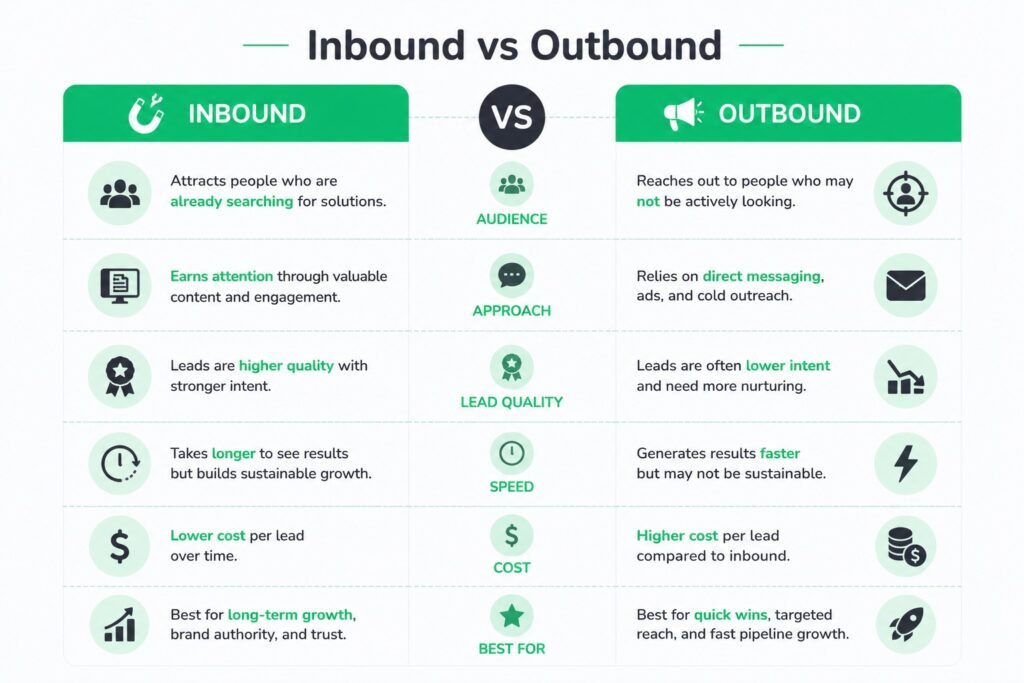
Inbound lead generation
Inbound is about making your business easy to find when potential clients are already looking. Search engine optimization, content marketing, social media, and paid search advertising all fall into this category. Someone searches for a solution to their problem, finds your website, and takes an action that makes them a lead.
Inbound leads tend to be higher quality because the person has already demonstrated intent. They were actively looking for something before they found you.
Outbound lead generation
Outbound is about going to find potential clients rather than waiting for them to come to you. Cold email, paid social advertising targeting specific audiences, LinkedIn outreach, and cold calling are outbound tactics. You identify who fits your ideal customer profile and reach out directly.
Outbound generates pipeline faster but typically requires more effort per lead since you are interrupting people who were not already searching for you. The average cold email response rate sits at around 5.1%, which means outbound works best when the targeting is sharp and the messaging is genuinely relevant.
How Lead Generation Works Step By Step?
Understanding the mechanics makes it easier to see where your own process might be losing potential clients.
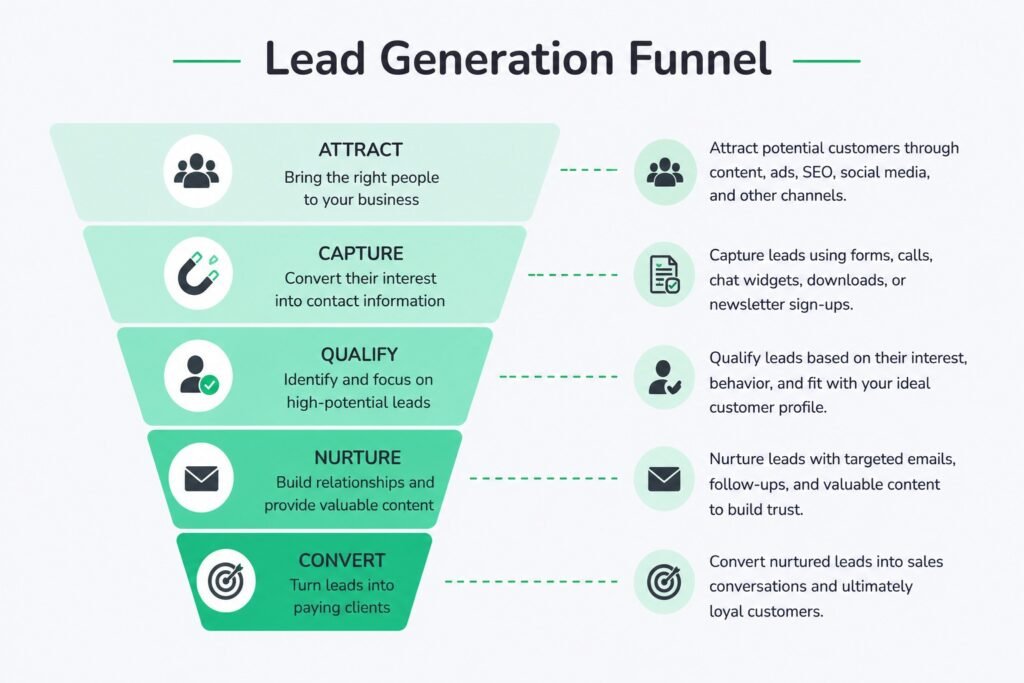
- Attract: the first job is getting the right people to notice you, whether through search rankings, ads, social content, or direct outreach.
- Capture: once someone is on your website or engaging with your content, a lead capture mechanism converts their attention into contact information, typically a form, a phone call, a chat widget, or a content download.
- Qualify: not every lead is worth pursuing equally. Qualification filters out low intent contacts and prioritises those most likely to buy, saving sales time and improving close rates.
- Nurture: most leads are not ready to buy immediately. Companies that nurture leads through targeted follow up generate 50% more sales ready leads at 33% lower cost, according to Forrester Research.
- Convert: the nurtured lead becomes a sales conversation, then ideally a paying client.
The median B2B website conversion rate across industries is 2.9%, based on Ruler Analytics’ analysis of over 100 million data points. That means for every 100 people who visit your website, roughly three take an action that makes them a lead. Improving that rate, or the volume of traffic reaching your site, is where most lead generation investment goes.
The Channels That Actually Drive Leads
Not every channel performs equally, and the right mix depends on your business type, budget, and how quickly you need results.
SEO and content marketing
For B2B businesses, the top channels for ROI are website, blog, and SEO combined, according to HubSpot’s State of Marketing report. SEO leads also close at a 14.6% rate compared to just 1.7% for outbound marketing, a significant quality advantage. The trade off is time: SEO builds momentum over months rather than days.
Paid advertising
Google Ads and Meta Ads generate leads faster than organic channels. The median conversion rate for Google Ads in B2B is 2.91%. Paid social converts at a lower rate (around 0.9%) since the audience is browsing rather than actively searching, but it reaches people who would never have found you organically, making it a strong tool for building awareness and targeting specific demographics.
Email marketing
41% of marketers rank email as the most effective channel for prospecting and sales growth. For B2B specifically, 42% name email as their most effective lead generation channel. When a list is warm and messaging is personalized, email converts significantly above average. Brands using personalization increase email ROI by nearly 260% compared to those that send generic campaigns.
Social media
LinkedIn dominates B2B lead generation on social platforms, accounting for 80% of B2B social media leads. For B2C businesses, Instagram and Facebook drive stronger results. TikTok is growing rapidly as a lead generation channel, with 39% of users visiting a separate website after discovering something on the platform.
Direct outreach
Cold email combined with LinkedIn outreach and calling reaches buyers who are not yet searching. While response rates are lower than inbound channels, the ability to target specific companies and decision makers makes outbound particularly valuable for higher ticket B2B services.
Lead Quality Matters More Than Lead Volume
One of the most common mistakes businesses make is optimizing for lead volume rather than lead quality. More leads sound better on paper, but leads that will never buy waste sales time and skew your data.
61% of marketers say generating high quality leads is their single biggest challenge in 2026, according to HubSpot. The emphasis has shifted from filling the top of the funnel with as many names as possible to ensuring the contacts entering the pipeline are genuinely likely to convert.
Lead scoring is the mechanism most businesses use to separate high value prospects from low intent contacts. It assigns points based on factors like company size, job title, the pages visited on your website, whether they have downloaded specific content, and how recently they engaged. 40% of leads are scored between 41 and 60 out of 100, which reflects how many sit in the middle of the quality spectrum and require nurturing before they become sales opportunities.

How to Measure Lead Generation Success?
Measuring lead generation performance requires looking beyond vanity metrics. High website traffic means little if none of it converts. A large social media following is irrelevant if it produces no enquiries.
The metrics that actually matter:
- Cost per lead: how much you spend to acquire each lead across different channels. The median B2B cost per lead reached £166 per lead in 2026, up 11% year on year, driven largely by paid search inflation.
- Lead to opportunity rate: what percentage of leads become genuine sales conversations. The median across B2B teams is around 13%, with top performing teams achieving 28% or higher.
- Conversion rate by channel: which sources produce the highest quality leads, not just the most leads.
- Time to conversion: how long it typically takes from first contact to closed deal, which varies significantly by industry and deal size.
Tracking these figures consistently is what separates businesses that scale their lead generation from those that spend without knowing what is working.
Why Businesses Invest in Lead Generation?
Running effective lead generation across multiple channels simultaneously requires expertise in SEO, paid advertising, content creation, email marketing, and data analysis. Few small or growing businesses have all of those skills in house, and attempting to build them from scratch takes time that most business owners do not have.
Working with a digital marketing agency or lead generation partner provides immediate access to those skills without the overhead of building an internal team. The key is finding a partner who understands your specific market and audience, not one applying a generic strategy that could belong to any business in any industry.
69% of B2B companies plan to increase their lead generation investment in the coming year. The businesses not investing are not standing still, they are falling behind the competitors who are.
Ready to Generate More Leads?
Lead generation is not about chasing everyone. It is about making sure the right people find you at the right moment, and giving them a clear reason to get in touch. That requires the right channels, the right message, and a process that runs consistently rather than in bursts.
At OutservePro, we build lead generation systems tailored to your business, not generic campaigns that could belong to anyone. If you want a clearer picture of what consistent, qualified lead flow could look like for your specific business, get in touch with our team and we will start with a straightforward conversation about what is actually possible.
Frequently Asked Questions
What is the difference between a lead and a prospect?
A lead is anyone who’s shown some interest and shared their contact info. A prospect is a lead that’s been qualified as a genuine potential buyer, based on things like budget, need, and whether they can actually make the decision. That filtering is what keeps sales focused instead of chasing dead ends.
How long does it take for lead generation to produce results?
Depends entirely on the channel. Paid ads can bring in leads within days. SEO usually needs 3 to 6 months before it shows real traction, and content marketing often peaks 6 to 12 months after publishing. Most businesses run a quick-win channel alongside a slower, long-term one at the same time.
How many leads does a business actually need?
Comes down to your deal value and close rate. If a client is worth £5,000 and you close 1 in 10 leads, you’ll need 10 qualified leads to hit that £5,000. Work backwards from your revenue goal and it tells you exactly what your pipeline needs.
Is lead generation different for B2B and B2C?
Yes, quite a bit. B2B usually means longer sales cycles, multiple decision makers, and more nurturing before anyone buys. B2C moves faster, higher volume, and is more emotionally driven. Same end goal, but a very different playbook.
What makes a lead generation strategy actually work?
Consistency, targeting, and tracking. Show up where your audience already is, with a message that actually speaks to them, and keep putting budget behind whatever channel is genuinely delivering. There’s no shortcut, just steady execution.
What’s a good conversion rate for lead generation?
It varies by channel and industry, but the average B2B website conversion rate sits around 2.9%. Paid search tends to do a bit better, and email marketing with a warm list can go well above that. Honestly, the best benchmark is your own past performance, not some industry average.
Share this post: