
Introduction
Across almost every account we manage, we see the same starting point. A business has a good product, a decent website, and almost no visibility on Google. Customers are searching for exactly what they offer every single day, and never once see it in the results. Instead, a competitor with a weaker product, sometimes a noticeably weaker one, is capturing that traffic simply because they showed up first on the page.
Over the years, we’ve spoken with business owners who could not understand why a rival with worse reviews and a clunkier website was outperforming them month after month. The honest answer is almost never about the product. It is about visibility, and that trust has to be earned deliberately. That gap between deserving customers and actually reaching them is what SEO exists to close.
Get Expert SEO Services For Your Business
What SEO Actually Means?
SEO stands for search engine optimization, the practice of improving a website so it appears higher in search results for the terms people actually use to find businesses like yours. It covers everything from the words on a page, to how fast that page loads, to how many other trusted websites link back to it, to whether Google can even find and read the page in the first place.
In our experience most business owners understand SEO in theory but underestimate how much it actually controls. Organic search drives roughly 53% of all website traffic on average, more than any other single channel including paid ads and social media combined for most industries.
For B2B websites specifically, that figure climbs even higher, since business buyers tend to research extensively before ever contacting a sales team. If a business is not visible there, it is invisible to the majority of people actively looking for what it sells, no matter how good that product or service actually is.
Why Is Google Ranking Position So Important?
One common misconception is that being anywhere on page one is good enough. The data tells a different story. The first organic result earns close to 28% of all clicks on average, while the top three results together take over half of all clicks on the page. Everything below that drops sharply, and very few users ever scroll to page two at all, treating it as though it does not exist.
This is not a small gap. Moving up even one position on Google can lift click through rate by roughly 32% on average, and moving from second to first place can bring in nearly 75% more clicks. In practice, We’ve seen businesses double their inbound enquiries simply by moving three or four positions higher for a handful of keywords, without changing anything else about their website or offer. For example, one client moved from position 11 to position 3 for a high-intent commercial keyword, and organic enquiries increased by 68% over the following four months. The product did not improve. The visibility did.
How SEO Improves Your Google Rankings?
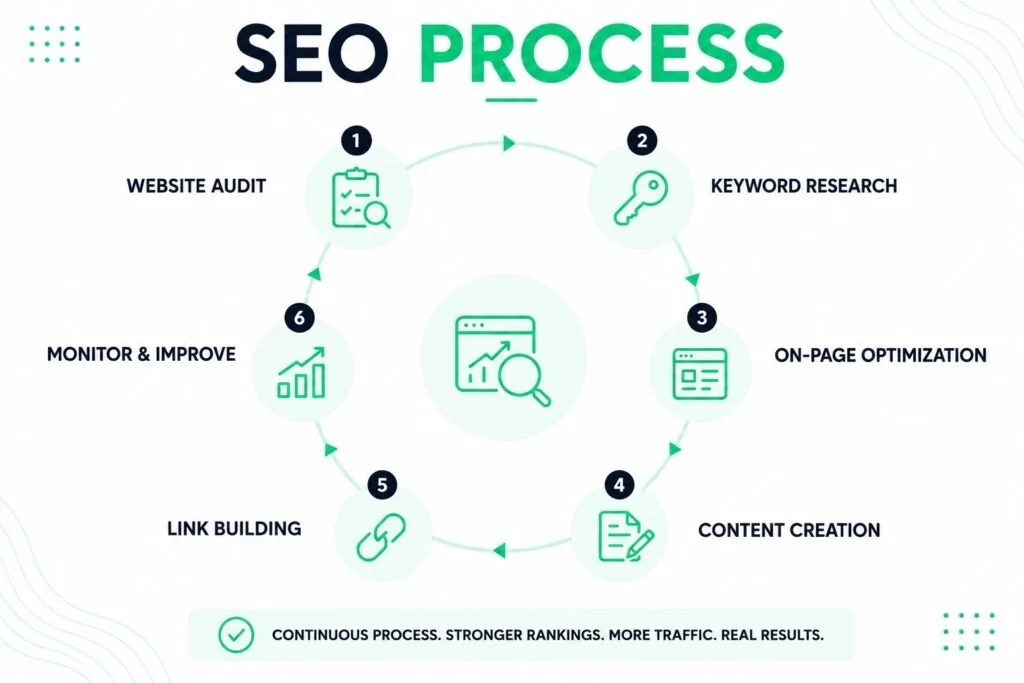
Good SEO usually rests on three connected areas, and we have found that businesses who only focus on one tend to plateau quickly, no matter how much effort goes in.
- Technical SEO makes sure a website can actually be crawled and indexed properly by Google. This includes site speed, mobile friendliness, clean site structure, and fixing broken links or pages accidentally hidden from search engines through simple configuration mistakes.
- Content and keywords determine whether a page actually answers what someone is searching for. This means researching real search terms, understanding the intent behind them, then creating pages that genuinely address the questions people are asking rather than guessing at what sounds good.
- Authority and backlinks signal to Google that other trusted sites consider your content worth referencing. Pages ranking in the top position tend to have significantly more backlinks than pages sitting further down the results, often by a wide margin.
Recent Google updates have placed increasing emphasis on E-E-A-T, meaning experience, expertise, authoritativeness, and trustworthiness. Content written by people who clearly understand the subject, backed by real credibility signals rather than generic filler text, consistently performs better, especially since the most recent rounds of algorithm updates began rewarding genuine depth over surface level keyword stuffing.
Local SEO vs National SEO: What’s the Difference?
One distinction we clarify with almost every new client is that SEO is not a single, one size fits all strategy. A business serving customers in one city needs a very different approach from one competing nationally.
Nearly half of all Google searches now carry local intent, and the businesses that show up in the local map pack tend to receive dramatically more calls, clicks, and direction requests than those ranked further down the page. For local businesses, a complete, actively managed Google Business Profile is often the single highest leverage piece of the entire strategy, sometimes mattering more than the website itself.
National SEO, by contrast, relies far more heavily on broad content authority and backlinks from across the web, since there is no map pack or physical location signal to lean on.
Many businesses waste months optimizing for the wrong strategy. A local plumber chasing national keyword volume, or a nationwide software company pouring effort into location pages it does not need, are both fighting the wrong battle.
Why SEO Takes Time, and Why That’s a Good Thing?
One thing we always tell new clients honestly is that SEO is not instant. It typically takes three to six months for new content to start ranking meaningfully, and industry data shows barely 6% of newly published pages reach the top ten within their first year. This is often the exact point where businesses give up, right before the results start compounding.
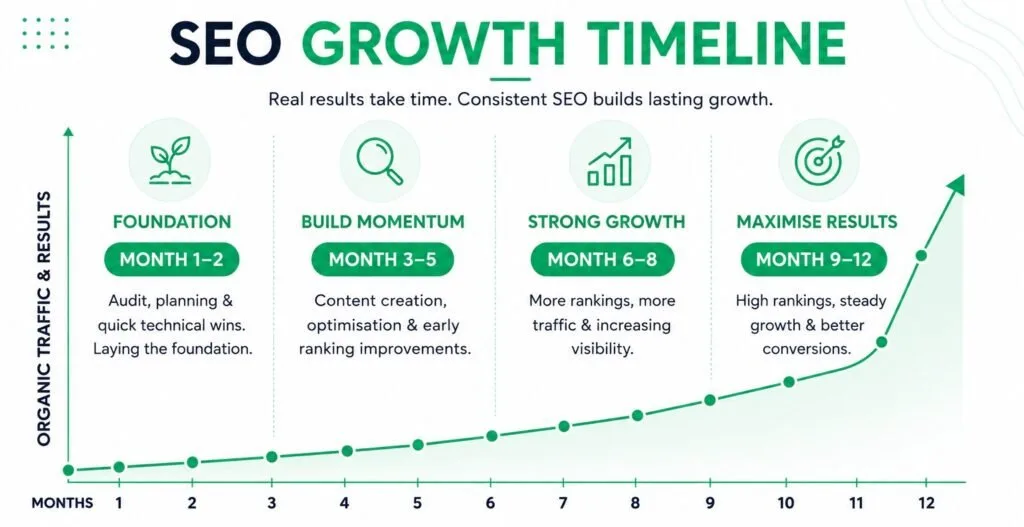
The upside is what happens after that point. Unlike paid advertising, which stops the moment spending stops, a well ranked page can continue generating traffic and leads for years with little ongoing cost. In our own client accounts, this compounding effect is consistently what turns SEO into the highest return channel over an eighteen to twenty four month window, even though it is rarely the fastest one out of the gate. Patience is not just helpful here, it is the entire mechanism that makes SEO work.
The Real Cost of Not Investing in SEO
We have audited more websites than we can count that were losing business simply because they were invisible for searches their own customers were typing every single day. Industry research backs up what we see constantly. SEO delivers an average return of roughly 700% or more over time, well above most paid channels, and 91% of marketers who invested properly in SEO report a positive return on that investment.
The flip side of that number matters just as much. The vast majority of web pages on the internet receive zero organic traffic from Google, largely because they were never properly optimized for the searches that actually matter to their business. Every day a business skips SEO, that gap does not stay empty. It is being filled by a competitor who did the work first.
The SEO Tools Behind Our Strategy
Strong SEO work depends on having the right data, not guesswork or gut feeling. Our team regularly uses a mix of tools including Ahrefs and SEMrush for keyword research and competitor analysis, Google Search Console for tracking indexing and search performance directly from Google, Google Analytics for measuring how organic traffic actually behaves once it lands on a site, Screaming Frog for technical site audits, and Moz for monitoring domain authority and backlink profiles over time. Combining these gives a full, accurate picture rather than relying on a single number pulled from a single source, which is where a lot of guesswork based SEO tends to go wrong.
Signs Your Business Has an SEO Problem
A few patterns tend to repeat across the sites we take on before working with us.
- Competitors with a weaker product or service consistently appear above you in search results.
- Website traffic has stayed flat for months despite regular social media activity.
- Most traffic comes from paid ads or referrals, with almost nothing from organic search.
- Content exists on the site but rarely targets the actual terms customers search for.
- Nobody on the team can say with confidence which keywords the site currently ranks for.
- The website was built for looks, and search visibility was never part of the original plan.
If several of these sound familiar, the issue is rarely a lack of good content ideas. It is usually a lack of strategy behind how that content actually gets found in the first place.
How OutservePro Handles SEO Differently?
This is where we spend most of our time with clients, because SEO done properly is rarely a one time project. As a dedicated digital marketing agency, we build SEO strategy around real keyword research, technical audits, and content built to genuinely answer what people are searching for, not just to hit a word count or tick a box.
Every campaign we run is measured against real ranking data, not vague promises about traffic. We track keyword movement, organic conversions, and technical health continuously, adjusting the strategy as search behaviour and algorithms shift, rather than setting a plan once and leaving it untouched for months while competitors keep moving.
The Bottom Line
SEO is not a quick fix, and it was never meant to be one. It is a compounding asset, one that gets more valuable the longer it is properly maintained, and one of the very few marketing investments that keeps paying returns long after the active work slows down.
The businesses winning their market right now are rarely the ones with the biggest budgets. They are the ones who understood early that visibility has to be earned deliberately, then stayed consistent long enough for that effort to compound.
FAQ’s
Frequently Asked Questions
How long does SEO take to show results?
Most businesses start seeing meaningful movement within three to six months, though highly competitive industries can take longer. Results tend to compound significantly after the first year rather than growing at a steady, predictable rate.
Is SEO better than paid advertising?
They serve different purposes. Paid ads generate traffic instantly but stop the moment spending stops. SEO takes longer to build but continues generating traffic and leads with little ongoing cost once a page ranks well.
How much does SEO cost for a small business?
Costs vary widely depending on competition and goals, but most people observe SEO as an ongoing monthly investment rather than a single project, since rankings need to be maintained and improved over time.
Do small businesses actually need SEO, or is it just for large companies?
Small businesses often benefit the most, since local and niche searches tend to have less competition, meaning a smaller, well optimized site can outrank much larger competitors for the searches that matter most to it.
What is the biggest mistake businesses make with SEO?
Treating it as a short term project rather than an ongoing strategy. Rankings that are won can also be lost if content stops being updated or competitors keep improving while a site stands still.
What is the difference between on page and off page SEO?
On page SEO covers everything within direct control on the website itself, such as content, keywords, and page structure. Off page SEO covers external signals like backlinks and brand mentions, which depend on other websites and are harder to control directly, though they carry significant ranking weight.
Can a business do SEO on its own, or does it need an agency?
Small, simple improvements can be handled internally, but competitive SEO usually requires ongoing keyword research, technical audits, and content strategy that most internal teams do not have the time or specialized tools to maintain consistently alongside their regular work.