

Introduction
Ask five business owners how much they spend on ads, and you’ll get five different answers, usually followed by a shrug. Some picked a number because it felt affordable. Others matched a competitor. A few just kept increasing it until something worked.
None of that is really a budget, it’s a guess dressed up as a decision, and guessing with ad spend is expensive. Unlike most business costs, spend doesn’t scale with return. Spend badly, and doubling the budget just means losing money twice as fast.
If you want a quick number, most local trades start testing between £300 and £800 a month. But that figure means little without knowing why, and getting it wrong either way can cost more than the ad spend itself.
There’s no single number that works for every UK SME. What there is, is a sensible way to work out what your business should actually spend, and that’s worth far more than a number borrowed from someone else’s.
Not Sure What a Realistic Ads Budget Looks Like for You?
Every business is different, and so is the right starting budget. We’ll help you work out a number based on your actual goals, not a guess.
Why There’s No Universal Number?
A one person trades business covering a 15 mile radius and a multi location service company have completely different cost structures. What makes sense for one can be excessive, or far too conservative, for the other.
This is why generic advice rarely holds up:
- “Spend £500 a month” ignores how competitive your market is
- “Spend 10% of revenue” ignores your actual profit margin
- Matching a competitor’s spend ignores that their customer value might be nothing like yours
The starting point isn’t a number. It’s a set of questions specific to your business.
What Actually Determines Your Budget?
Before landing on a figure, it’s worth being honest about a few things:
- Customer value: How much is a new customer worth, including repeat work over time, not just the first job?
- Market competition: More businesses bidding on the same keywords means a higher cost per click.
- Consistency: How much can the business commit to every month, since stopping and starting a campaign wastes money rather than saving it.
A customer worth several thousand pounds over time justifies a meaningfully higher spend than one worth a modest one off sale, since the return looks completely different once lifetime value is factored in.
A Simple Way to Calculate Your Starting Budget
Rather than guessing, work through it in order:
- Work out your average customer value, including repeat business and referrals, not just the first invoice.
- Set a test budget you can commit to for six to eight weeks. This is data gathering, not a guarantee of profit from day one.
- Track cost per click and conversion rate once live, to see what a lead is genuinely costing to acquire.
- Compare that cost against your customer value. If a lead costs a fraction of what a customer is worth, there’s room to spend more. If it’s close to breaking even, fix the campaign before increasing spend.
This turns budgeting into a calculation based on your own numbers, not a figure copied from somewhere else.
What This Looks Like in Practice
Most local trades and service businesses tend to start testing between £300 and £800 a month on Google Ads. Businesses in more competitive markets, or covering a wider area, often need £1,000 to £2,000 to gather the same volume of useful data, since cost per click tends to be higher.
These figures aren’t a rule, they shift with your industry and location. Treat them as a starting point to adjust from, not a number to follow blindly.
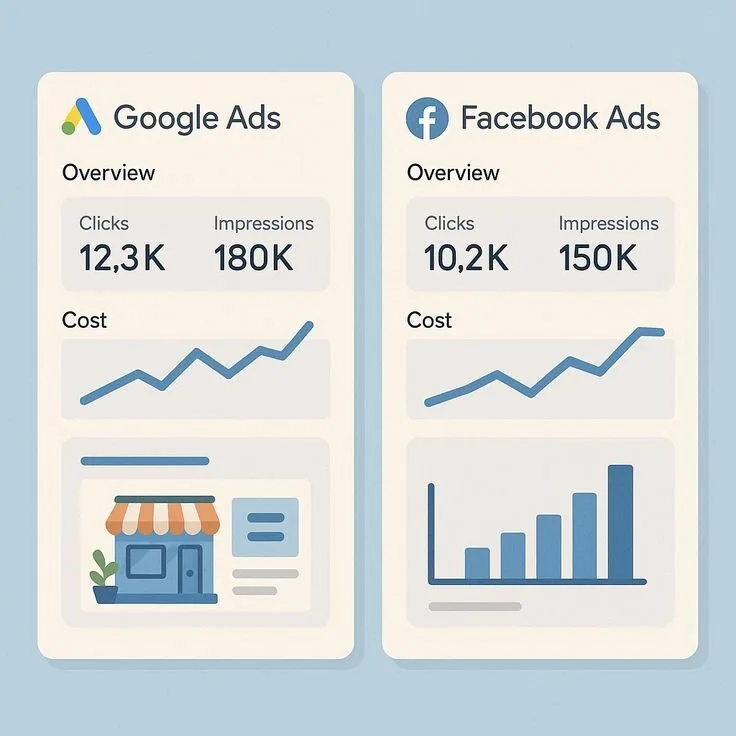
Google Ads vs Meta Ads: Which Makes Sense for You?
Paid ads isn’t just Google. Meta Ads, covering Facebook and Instagram, works on a different principle, and your budget should reflect that rather than treating every platform the same.
Google Ads makes more sense when:
- Customers are actively searching for what you offer, “emergency plumber near me,” or “solar panel installation quote”.
- The service has clear, immediate demand.
- You want to reach people close to deciding, not just becoming aware.
Meta Ads makes more sense when:
- Your offer benefits from strong visuals, before and after photos, finished projects, a physical product.
- You’re building awareness for something people don’t actively search for yet.
- You want to retarget past customers or website visitors.
- Your audience spends significant time on Facebook or Instagram.
For most UK SMEs, Google Ads tends to convert existing demand more efficiently, while Meta Ads is better suited to creating demand or staying visible to people who already know you. Many eventually use both, just not split evenly by default.
Already Spending on Ads But Not Sure If It’s Working?
If your current ad spend isn’t producing clear results, the issue might be the platform, the budget, or what’s happening after the click. We’ll help you find out which one it is.
Where the Budget Actually Needs to Go
Ad spend is only part of the equation. Budget also needs to cover:
- Setting campaigns up properly from the start.
- Writing ad copy and creative that actually converts.
- Reviewing performance regularly, not leaving campaigns untouched for months.
A larger budget poorly managed will often underperform a smaller one that’s properly optimized, especially with Google Ads, where unmanaged campaigns drift toward less efficient keywords over time.
Common Mistakes That Waste Ad Budget
A few patterns show up repeatedly in businesses whose ad spend isn’t working:
- Spreading a modest budget too thinly across several platforms instead of doing one properly first.
- Judging results after a few days rather than giving campaigns time to gather real data.
- Increasing spend on a campaign that was never generating quality leads in the first place.
It’s also worth checking that the website behind the ads actually converts the traffic being paid for. If this sounds familiar, it’s worth reading about why clicks aren’t turning into leads before assuming the budget is the problem.
The Bottom Line
There isn’t a single correct number for paid ad spend in 2026. Any answer that gives you one without understanding your business, margins, and goals is guessing just as much as picking a number at random.
What matters more is treating spend as an investment worth reviewing and adjusting based on real performance data, not a set and forget monthly cost. Getting the approach right consistently outperforms getting the number right once.
How OutservePro Approaches Ad Budgets
At OutservePro, we don’t hand UK SMEs a generic budget recommendation before understanding their business. Our digital marketing and Google Ads team looks at your margins, customer value, and competition before suggesting where to start, including whether Google Ads, Meta Ads, or a mix of both fits your goals better.
We manage campaigns actively rather than leaving them to run untouched. If you’re weighing up SEO against paid ads entirely, it’s also worth reading our thoughts on which one deserves your budget first.
If you’re not sure what a sensible ads budget looks like for your business, it’s worth getting an honest answer before committing to a number.
Get a Free Ad Spend Recommendation
FAQ’s
Frequently Asked Questions
How much should a small business spend on Google Ads per month?
There’s no fixed figure that applies to every business, but as a rough starting point, many local trades and service businesses begin testing somewhere between £300 and £800 a month, with more competitive markets often needing £1,000 to £2,000 to gather the same level of useful data.
Should I spend my budget on Google Ads or Meta Ads?
It depends on your service. Google Ads tends to work better when customers are actively searching for what you offer, while Meta Ads suits businesses relying on visuals, awareness, or staying visible to people who already know the brand. Many UK SMEs eventually use both, just not with an evenly split budget by default.
Is a small ad budget a waste of money?
Not necessarily, but a budget spread too thin across multiple campaigns or platforms often struggles to gather enough data to optimise properly. It’s usually better to commit a modest budget to one channel first rather than splitting it too thinly.
How long before I know if my ad spend is working?
Most campaigns need at least a few weeks of consistent spend before there’s enough data to judge performance fairly. Judging results after just a few days rarely reflects how a campaign will actually perform once it settles.
Should ad spend be based on a percentage of revenue?
It can be a useful starting reference for some businesses, but it shouldn’t be treated as a rule. Two businesses with the same revenue can have very different customer values and margins, which affects what actually makes sense to spend.
What’s more important, the ad budget or how it’s managed?
Management matters just as much, often more. A smaller budget that’s actively reviewed and optimised regularly frequently outperforms a larger one left to run without attention.
Should I increase my ad budget if I’m not getting results?
Not automatically. It’s worth first understanding why the current spend isn’t converting, whether that’s the platform, targeting, ad copy, or the website itself, since increasing budget on an underperforming setup usually just increases the losses.